
Imagine you’re a jeweler staring at a photo of your stunning diamond ring, but dust spots and odd reflections make it look dull instead of dazzling. That’s where professional jewelry retouching steps in like a magic polish that turns raw shots into sales magnets.
This comprehensive guide from Pic Visual walks you through everything from basics to pro-level techniques, helping you understand how expert retouching transforms ordinary jewelry photos into irresistible product images that drive conversions.
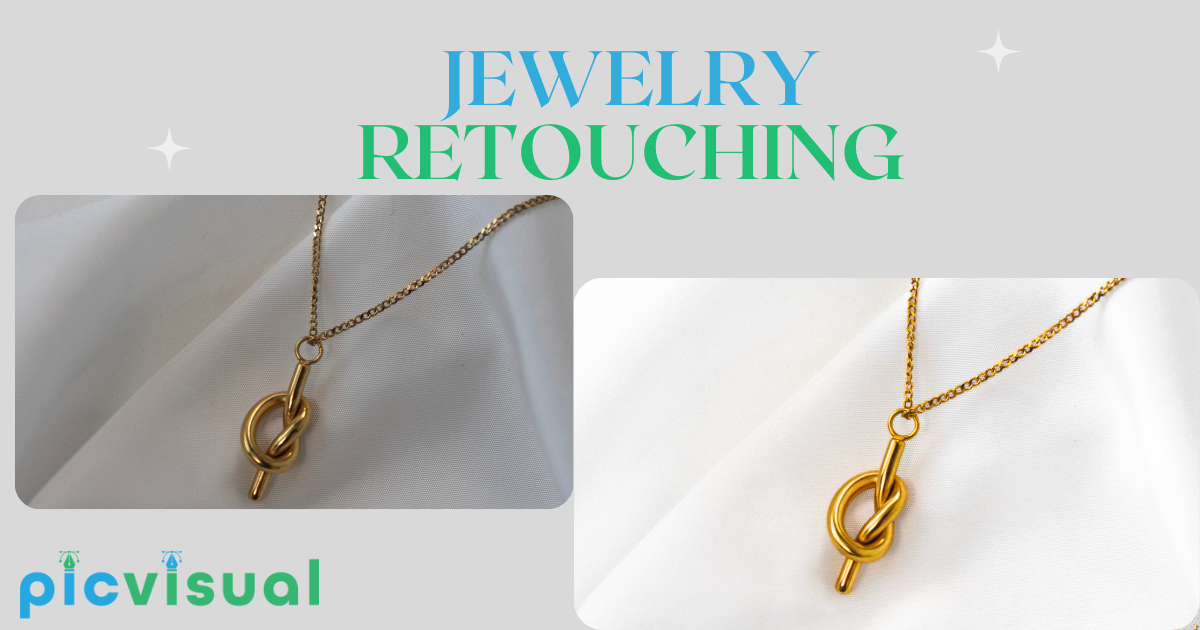
Whether you’re a jeweler managing a 500-piece catalog, a photographer scaling your studio workflow, or an agency preparing luxury watch campaigns for print, this guide covers the entire landscape ofjewelry retouching services.
You’ll discover specialized techniques for different metal types, learn how gemstone enhancement differs from basic cleanup, and understand pricing tiers that match your budget and quality needs.
Pic Visual specializes in delivering professional results that enhance your jewelry’s natural beauty while maintaining authentic product representation.
New to professional jewelry retouching?
Experience the Pic Visual difference with our free trial service. Upload your jewelry images and see firsthand how expert retouching transforms product photography into conversion-driving visuals.
What Is Jewelry Retouching?
Picture capturing your necklace under harsh studio light—the final image shows scratches you never noticed, fingerprints on polished surfaces, and glare that drowns out the sparkle.
Jewelry retouching is the specialized post-production process that removes these flaws while enhancing the natural brilliance of metals and gemstones without misrepresenting the actual product.
Unlike general photo retouching that might work for portraits or landscapes, jewelry retouching demands pixel-level precision.
A professional retoucher at Pic Visual understands how light interacts with platinum versus white gold, knows that diamond facets require different enhancement than colored gemstones, and can remove dust particles without destroying the texture of brushed metal finishes.
How Jewelry Retouching Differs from General Photo Editing
General photo editing tools like basic brightness adjustments or one-click filters fail when applied to jewelry because metal reflections, gemstone transparency, and microscopic surface details need individual attention.
A scratch on a gold band requires selective healing that preserves the surrounding polish. A dusty diamond needs cleaning that maintains facet structure and fire.
Professional jewelry retouching handles challenges that standard editing ignores: controlling complex reflections on curved surfaces, balancing highlights so metal looks luminous without blown-out whites, and enhancing gemstone brilliance while keeping color accurate to the actual stone.
These specialized skills separate amateur fixes from professional results, similar to how fashion photo retouching requires specific expertise for textiles and skin tones.
Key Benefits of Professional Jewelry Retouching
Professional retouching directly impacts your bottom line. E-commerce data shows that jewelry listings with professionally retouched images convert at significantly higher rates than unedited photos.
Customers can zoom into crisp, clean product shots that build confidence in the purchase, reducing return rates from unmet expectations.
Time savings matter for busy jewelers and photographers. Sending 50 ring photos to a professional service like Pic Visual frees you to focus on shooting new pieces or serving customers rather than spending hours in editing software.
White-label retouching services let photography studios scale without hiring in-house retouchers, maintaining brand quality across growing client rosters—similar to how editorial retouching services support publishing workflows.
Consistency across your entire catalog becomes achievable. Whether you’re photographing engagement rings or luxury watches, professional retouchers apply the same quality standards to every image, ensuring your Amazon storefront or Shopify catalog maintains visual coherence that reinforces brand trust.
Jewelry Retouching Fundamentals
Think of fundamentals as your evaluation toolkit for understanding what quality jewelry retouching entails. When assessing potential retouching providers or DIY attempts, knowing what flaws to fix and which goals to prioritize helps you make informed decisions about service tiers and pricing.
Common Flaws Addressed in Jewelry Photography
Dust particles appear in nearly every jewelry photograph, even in controlled studio environments. These tiny specks land on metal surfaces, nestle between prongs, and stick to gemstone facets.
Professional cleanup identifies and removes each dust spot through careful clone-stamping and healing, preserving the underlying texture.
Scratches and wear marks show prominently under photography lighting, especially on polished surfaces like gold bands or silver chains.
Retouching smooths these imperfections while maintaining the metal’s natural luster, distinguishing between intentional finishes like brushed texture and unwanted damage.
Fingerprints and oils from handling jewelry during photography create smudges that dull reflective surfaces. Removing these requires understanding how clean metal should reflect light—too much smoothing makes surfaces look fake, while insufficient cleanup leaves visible contamination.
Retouching Goals: Clarity, Sparkle, and Accuracy
Clarity means every detail customers care about appears sharp and visible. Prongs holding diamonds should show crisp edges, engraved text must remain legible when zoomed, and chain links need distinct separation rather than blurring together.
Professional retouching enhances clarity through selective sharpening that targets product features without amplifying noise.
Sparkle enhancement for gemstones walks a fine line between genuine brilliance and over-processing. Professional retouchers amplify the natural fire and scintillation that makes diamonds captivating, using dodging and burning techniques on individual facets. This differs from artificial glow effects that make stones look fake.
Color accuracy ensures customers receive what they see online. A rose gold ring must display true rose tones, not shifted toward yellow or copper. Sapphires should show their actual blue hue, not digitally saturated into unrealistic intensity.
Professional color correction uses calibrated monitors and color-managed workflows to maintain product honesty.
Service Tiers: Basic, Standard, and High-End
Basic cleanup services handle everyday catalog needs for jewelers with budget constraints or simple product lines. This tier removes obvious dust, scratches, and fingerprints, performs basic background removal to white or transparent, and ensures images meet marketplace requirements like Amazon’s white background rules. Turnaround runs fast, prices stay low per image, and results suit standard e-commerce displays.
Standard retouching adds metal surface refinement and gemstone enhancement to basic cleanup. Gold, silver, and platinum surfaces receive careful smoothing, reflection control, and highlight balancing.
Diamonds and colored stones get brilliance boosting through facet-by-facet attention. This tier suits jewelers needing professional polish for mid-range to high-end products without luxury campaign budgets.
High-end luxury retouching delivers pixel-perfect results for designer campaigns, large-format prints, and premium brand catalogs. Every microscopic detail undergoes inspection and refinement—tiny prong edges get sharpened, metal textures receive subtle enhancement, and complex composites combine multiple shots for impossible-to-photograph angles.
This tier involves senior retouchers spending hours on single images, justifying premium pricing through exceptional quality. Pic Visual’s high-end jewelry photo retouching exemplifies this level of craftsmanship and attention to detail.
Evaluating Retouching Providers
Before-after galleries reveal provider capabilities more honestly than marketing claims. Examine samples at 100% zoom to check if dust removal leaves artifacts, whether metal smoothing looks natural, and if gemstone enhancement maintains believable sparkle.
Weak portfolios show halos around extracted jewelry, overly smooth metal surfaces, or artificially intensified gem colors.
Process transparency indicates professional operations. Quality providers explain their workflow from intake through quality control checkpoints, specify turnaround times for different service tiers, and detail revision policies. Vague timelines or unlimited revisions often signal disorganized workflows that delay deliveries.
Technical capabilities matter for specialized needs. Ask about color space handling for print versus web delivery, file format options beyond basic JPEG, and experience with your specific jewelry types watchmakers need retouchers familiar with dial clarity and glass reflections, while gemstone dealers require expertise in colored stone enhancement beyond standard diamond work.
Core Jewelry Retouching Services Breakdown
Understanding individual service categories helps you specify exactly what your images need and communicate requirements clearly to retouching providers. Each service type addresses specific technical challenges in jewelry photography, from basic cleaning to advanced shape corrections.
Basic Jewelry Photo Cleanup
Basic cleanup forms the foundation of every retouching project, handling the most obvious flaws that distract customers from appreciating your jewelry.
Dust removal targets every speck visible on metal surfaces, gemstone facets, and backgrounds, using healing brushes and clone stamps that preserve underlying textures.
Scratch removal smooths wear marks on metal surfaces while maintaining the distinction between intentional finishes and damage. A brushed platinum band keeps its texture while losing unwanted scratches; a high-polish gold surface becomes mirror-smooth without looking plasticky.
Fingerprint elimination cleans oils and smudges from handling, restoring proper reflections on metal surfaces. This process requires understanding how clean metal interacts with light—effective cleanup makes surfaces look untouched by human hands while preserving natural luster.
Before-after comparisons for basic cleanup should show noticeably cleaner jewelry without altering the fundamental character of metals or stones.
Turnaround for this tier typically runs fastest, often within 24-48 hours for standard queues, making it ideal for high-volume catalog work where speed matters as much as quality.
Pic Visual offers streamlined basic cleanup services perfect for e-commerce catalogs requiring quick turnarounds.
Metal Surface Retouching for Gold, Silver, and Platinum
Metal retouching demands material-specific knowledge. Gold surfaces reflect warm light and show yellow or rose tones depending on alloy composition.
Professional retouching preserves these color characteristics while smoothing imperfections, controlling highlights to prevent blown-out whites, and balancing reflections so curved surfaces show dimension.
Silver and white gold present different challenges, displaying cooler reflections prone to harsh contrast between highlights and shadows.
Effective metal retouching softens this contrast without flattening surfaces into dull gray, maintaining the bright, crisp quality that makes white metals appealing while eliminating noise and distracting reflections.
Platinum requires the most subtle approach, balancing its naturally subdued luster against the need for visual interest.
Over-polishing makes platinum look like cheap silver; under-processing leaves it dull. Professional retouchers understand this balance, enhancing platinum’s quiet elegance without forcing artificial shine.
Reflection control separates amateur from professional metal retouching. Complex reflections from studio equipment, photographer hands, or room environments get replaced with clean, simple reflections that maintain surface believability.
Rings show appropriate light wraps around bands, chains display consistent link highlights, and bracelets exhibit smooth light fall-off across curves.
Gemstone and Diamond Retouching
Diamond retouching focuses on three key attributes: brilliance (white light return), fire (rainbow flashes), and scintillation (sparkle pattern).
Professional enhancement uses dodging and burning on individual facets to amplify these natural properties without creating artificial glow effects that scream “Photoshopped.”
Facet structure requires careful attention. Each diamond facet reflects light at specific angles, creating the stone’s characteristic pattern.
Retouching that ignores facet architecture produces unrealistic sparkle; proper enhancement works with the existing structure, deepening contrast between bright and dark facets to increase perceived brilliance.
Color cast removal ensures white diamonds appear neutral rather than tinted yellow, blue, or gray from photography lighting or metal reflections.
Colored gemstones like sapphires, rubies, and emeralds need accurate hue representation—a sapphire should display true blue tones matching the actual stone, not digitally saturated into cartoonish intensity.
Clarity enhancement reveals internal beauty without misrepresenting stone quality. Included diamonds keep visible inclusions (important for product honesty), while retouching removes dust on the surface and distracting reflections that obscure stone viewing. This distinction maintains ethical representation while maximizing visual appeal.
Shape and Symmetry Corrections
Ring warping occurs when camera lenses distort circular shapes into ovals, especially with wide-angle photography or off-center positioning.
Professional retouching uses perspective correction and manual warping to restore perfect circles, ensuring wedding bands appear round and solitaire settings look symmetrical.
Chain alignment fixes tangled or kinked links in necklace photography. Rather than reshooting, retouching straightens chains digitally, repositions clasps, and ensures even drape. This service proves especially valuable for delicate chains where physical manipulation during shooting risks damage.
Earring matching creates perfect symmetry for pairs photographed separately. Retouchers mirror one earring to create identical pairs, ensuring stud angles match precisely and hoop shapes display perfect roundness. This technique saves photography time while guaranteeing visual consistency.
Prong positioning corrects minor asymmetries in stone settings. While retouching cannot fix poor craftsmanship, it can align prongs that photograph at odd angles due to perspective, ensuring settings appear properly constructed and professionally finished.
Jewelry Color and Tone Correction
Metal color accuracy separates amateur editing from professional results. Yellow gold must display its characteristic warm tone without shifting toward orange or brass; rose gold needs proper pink-copper balance; white gold should read as bright and cool without gray muddiness.
White balance correction compensates for studio lighting that casts unwanted color tints. Mixed lighting scenarios (tungsten plus daylight, for instance) create particularly challenging corrections, requiring selective color adjustment that treats metals and gemstones differently within the same image.
Brand color matching matters for retailers selling specific jewelry lines. A designer might require exact Pantone color matching for signature metal finishes or enamel details.
Professional retouching services use calibrated monitors and color-managed workflows to hit these targets consistently.
Web versus print color requires different handling. Images for online display need sRGB color space with vibrant, screen-optimized tones, while print campaigns require Adobe RGB or CMYK conversion with color profiles matching the printing process. Quality retouching services handle these technical requirements seamlessly.
Background Removal for Jewelry Photos
White background removal dominates e-commerce retouching, driven by marketplace requirements from Amazon, eBay, and Etsy.
Professional extraction creates clean edges around jewelry, removes all shadows and reflections, and delivers pure white (RGB 255,255,255) backgrounds that pass automated marketplace checks.
Pic Visual’s background removal service specializes in precision edge work essential for jewelry photography.
Transparent background creation produces PNG files with alpha channels, allowing jewelry to layer over any background color or design. This format suits jewelers who display products on branded website templates or marketing materials requiring flexible background options.
Creative backgrounds go beyond simple white or transparent, placing jewelry on textured surfaces, lifestyle settings, or branded backdrops. These require more complex masking to preserve fine details like chain links and prong tips while integrating jewelry naturally into new environments.
File format delivery matters for background removal. JPEG files cannot support transparency, requiring PNG output. High-volume e-commerce operations might need WebP formats for faster website loading, while print applications demand TIFF files maintaining full color depth and sharpness.
Shadow and Reflection Creation
Drop shadow addition creates depth for jewelry floating on white backgrounds, preventing the flat, pasted-on look of hard-edge extractions. Professional shadow creation uses soft, directional shadows that suggest lighting angle and product dimension without overwhelming the jewelry itself.
Reflection shadows mimic jewelry placed on reflective surfaces, showing subtle mirror images beneath pieces. This technique adds realism to bracelet and necklace presentations, suggesting weight and presence while maintaining clean composition. Reflection intensity and blur require careful calibration—too strong looks fake, too subtle proves invisible.
Platform compliance governs shadow usage for e-commerce. Amazon allows subtle drop shadows but prohibits reflections; Etsy permits both with restrictions on shadow density; Shopify leaves options open.
Professional retouching services understand these rules, creating compliant shadows that maximize visual appeal within platform guidelines.
Realism maintenance separates quality shadow work from amateur attempts. Shadows should match lighting direction visible on the jewelry itself, fade naturally from dark to light, and maintain appropriate softness for the suggested distance between product and surface.
High-End Luxury Jewelry Retouching
Micro-detail refinement defines luxury retouching, where senior retouchers spend hours perfecting single images. Every prong edge gets individually sharpened, each facet receives custom enhancement, and metal textures undergo subtle refinement that preserves natural character while eliminating every microscopic flaw.
Complex composite creation combines multiple photographs into single images showing impossible angles or perfect clarity throughout. A ring photographed in sections (top view, side view, band detail) gets seamlessly merged into one image showing complete detail everywhere.
Watch dials might combine five shots to achieve edge-to-edge sharpness impossible in single captures. For even more advanced visualization,3D modeling services can complement photography for certain applications.
Campaign-ready output for large-format print requires extra resolution, meticulous attention to color accuracy, and specialized preparation for different printing processes.
Billboards, magazine spreads, and luxury catalogs demand quality levels beyond standard e-commerce work, justifying premium pricing through uncompromising excellence.
Brand consistency across entire campaigns involves creating detailed style guides that specify exactly how metals should look, what level of gemstone enhancement to apply, and how backgrounds should be rendered.
Luxury brands require pixel-perfect consistency across hundreds of images, achievable only through dedicated retouching teams following strict protocols.
AI-Assisted Jewelry Retouching
AI tools accelerate certain retouching tasks, particularly dust removal and basic cleanup where machine learning algorithms identify obvious flaws. These tools excel at high-volume processing for basic tier work, letting retouchers tackle thousands of images faster than manual methods.
Quality limitations emerge quickly with AI retouching. Algorithms struggle with complex reflections on metal surfaces, often creating unnatural smoothness or destroying subtle textures. Gemstone enhancement proves particularly problematic, as AI cannot understand facet architecture or distinguish between natural sparkle and artificial glow.
Hybrid workflows combine AI efficiency with human expertise. Initial AI passes remove obvious dust and perform rough cleanup, then professional retouchers refine results manually, fixing AI mistakes and adding nuanced enhancements algorithms cannot achieve. This approach balances speed with quality for mid-tier services.
Manual superiority remains clear for high-end work. Luxury retouching demands aesthetic judgment, material knowledge, and technical precision that AI cannot replicate. Understanding how platinum should reflect light, recognizing when diamond enhancement crosses into misrepresentation, and maintaining brand consistency across campaigns all require human expertise.
Jewelry Types We Handle
Different jewelry categories present unique retouching challenges. Understanding these category-specific needs helps you communicate requirements clearly and choose providers with relevant expertise for your product mix.
Ring Retouching Services
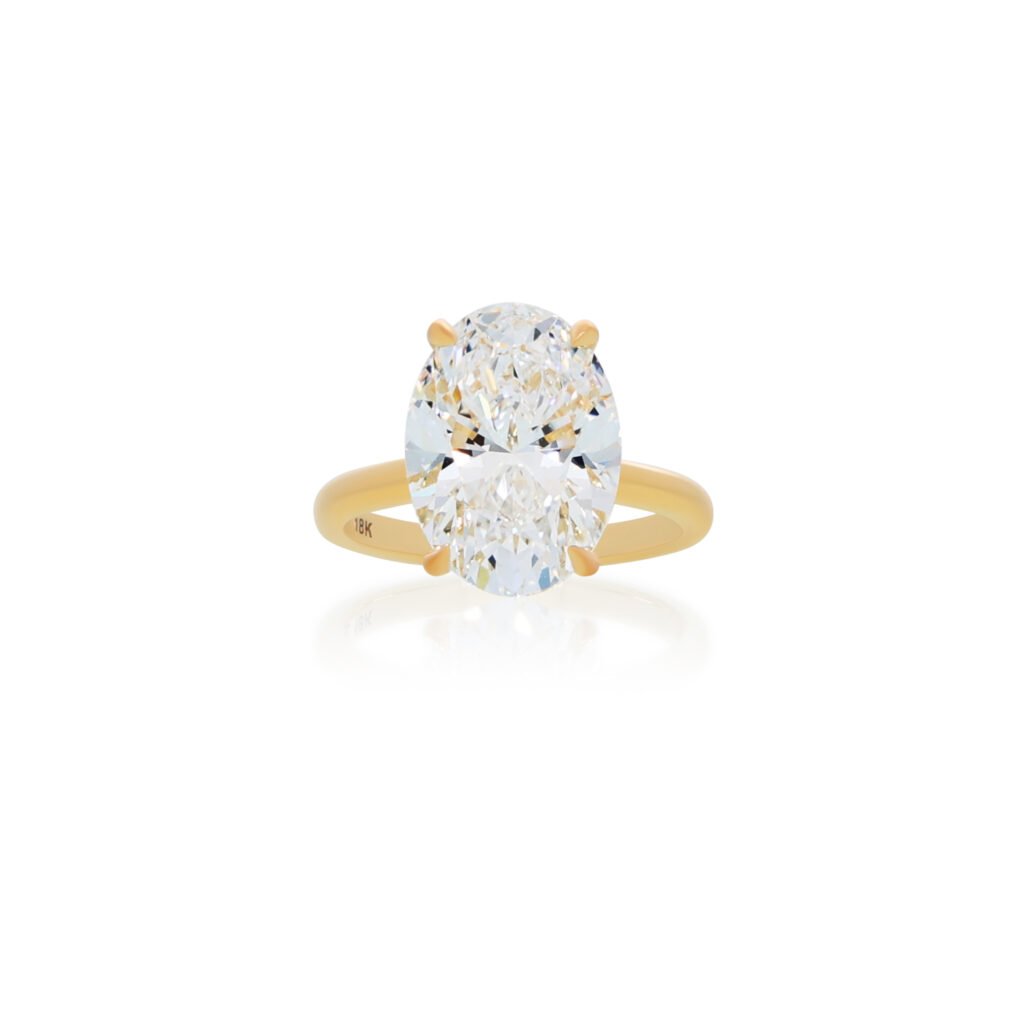
Engagement rings and wedding bands demand particular attention to solitaire settings, ensuring center diamonds appear perfectly positioned with symmetrical prongs. Retouching corrects minor perspective issues that make round stones look slightly oval or throw prong alignment askew.
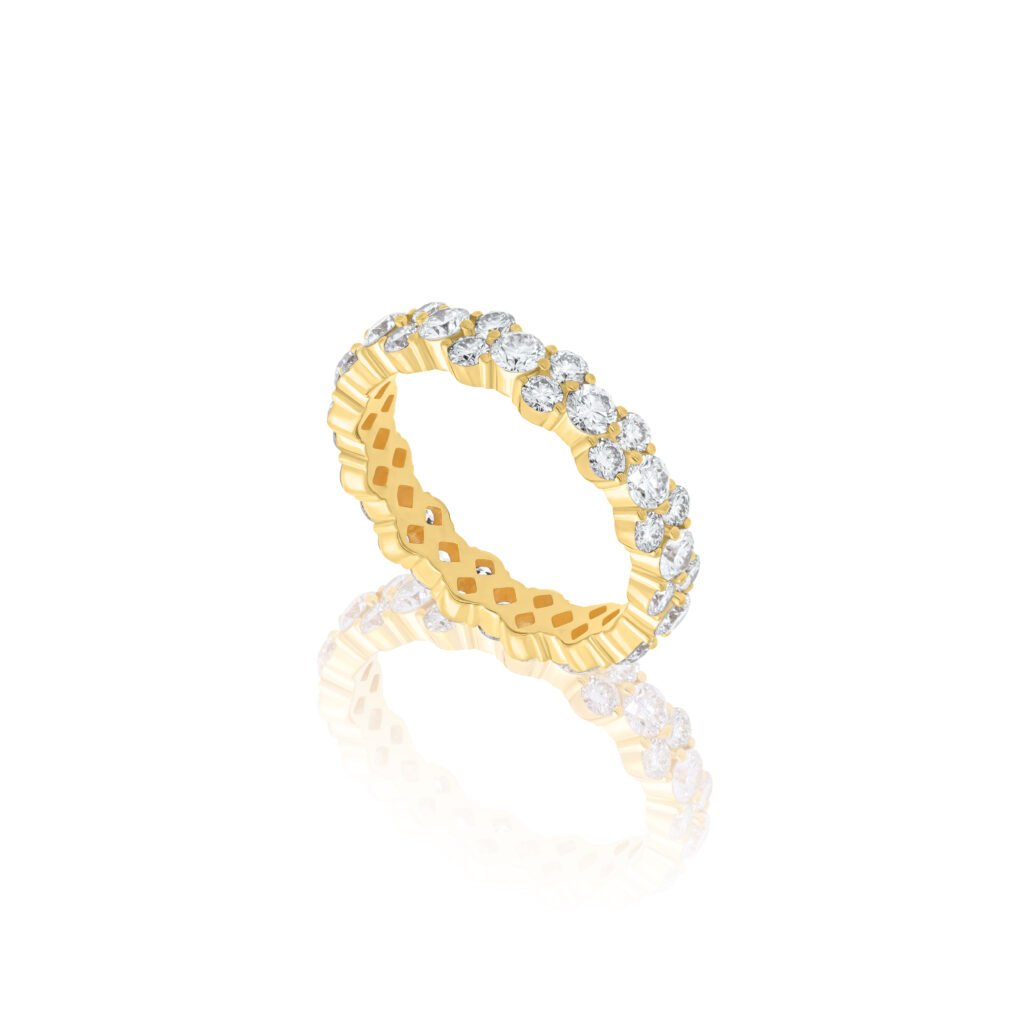
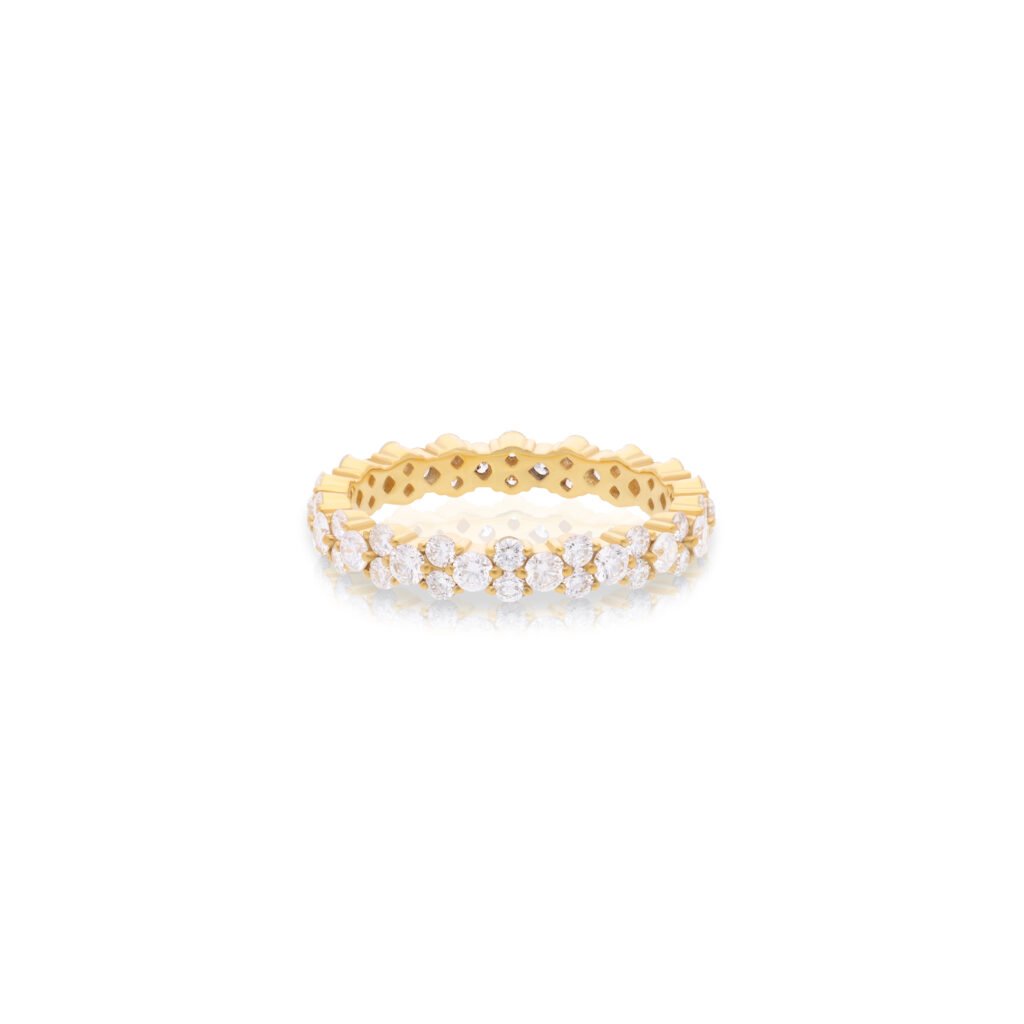
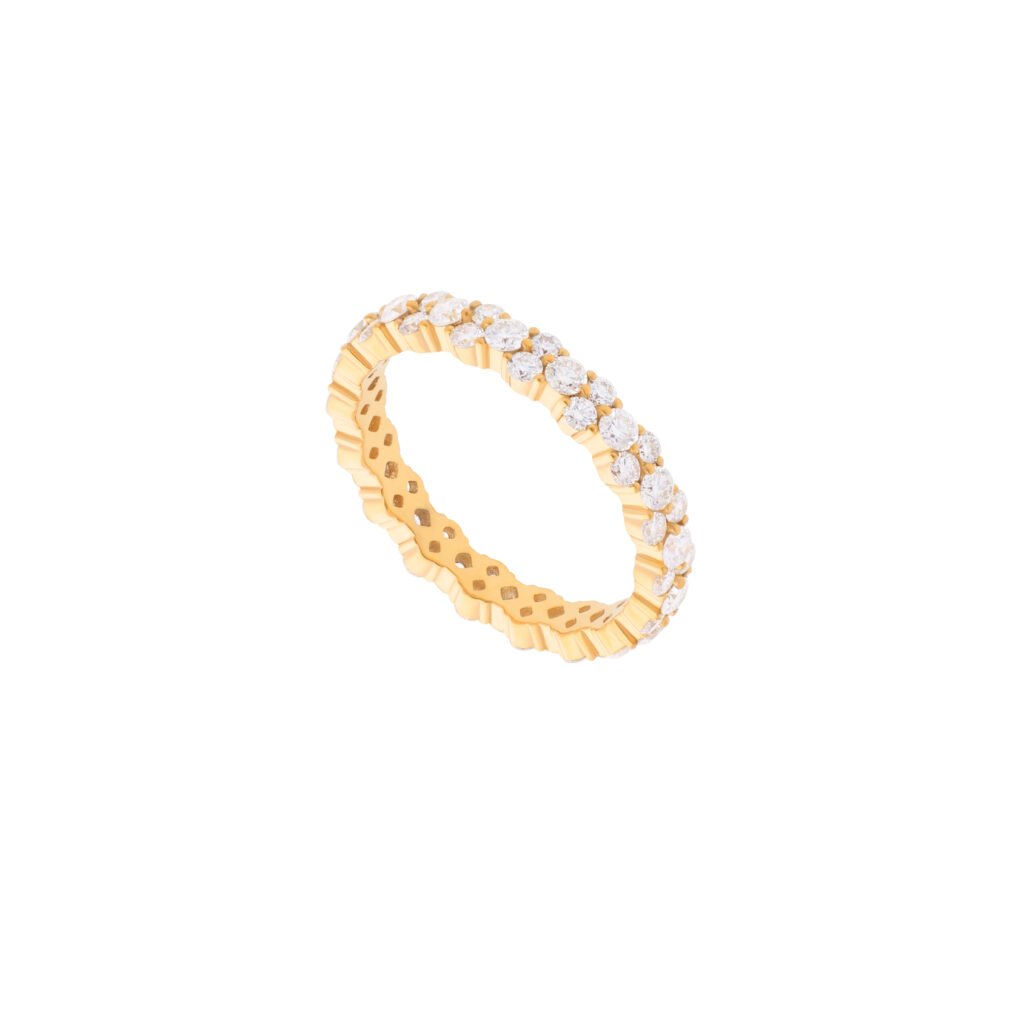
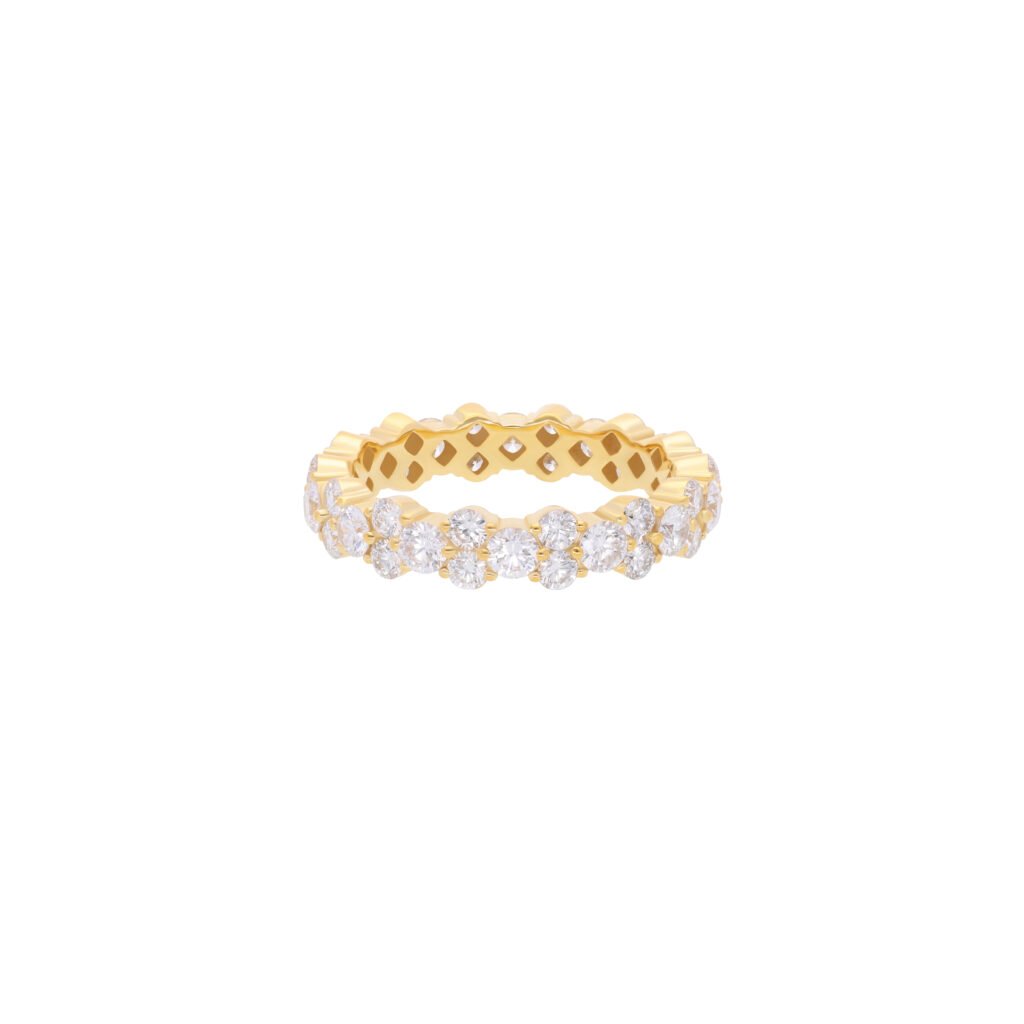
Metal band refinement varies by style. High-polish bands need mirror-smooth surfaces with controlled highlights, while brushed or hammered finishes require preserving intentional texture while removing scratches and wear marks. Eternity bands present challenges with multiple small stones needing individual enhancement.
Engraving clarity matters for personalized rings. Names, dates, and messages must remain legible when customers zoom into product photos, requiring selective sharpening and contrast enhancement on engraved areas without over-processing surrounding metal.
Reflection management proves critical for rings photographed at angles. Band curves create complex highlight patterns that need balancing—bright enough to show dimension and luster, controlled enough to avoid blown-out whites that obscure detail.
Necklace and Chain Retouching
Chain straightening removes kinks and tangles that occur during photography, digitally repositioning links for smooth drape without physical reshooting. This proves especially valuable for delicate chains where handling risks damage. For fashion jewelry displayed on models, ghost mannequin services and hollow man effect create professional invisible mannequin presentations.
Link clarity enhancement sharpens individual chain links so they remain distinct rather than blurring together. Zoom-level detail shows clean separation between links, smooth surfaces, and consistent reflections along chain length.
Pendant integration ensures centerpiece elements relate naturally to chains, with properly positioned bails and balanced composition. Retouching can adjust pendant angles slightly and clean attachment hardware without major restructuring.
Tangle removal addresses the frustration of photographing multiple-strand necklaces. Rather than spending hours untangling fine chains during shooting, retouching can digitally separate strands, remove crossovers, and create neat parallel draping.
Earring Retouching Services
Pair matching creates perfect symmetry between earrings photographed separately. One earring gets mirrored to produce identical twins, ensuring stud angles match exactly and hoop shapes display consistent roundness. This technique particularly benefits intricate designs where physical matching proves difficult during photography.
Tiny stone clarity challenges push retouching precision, as small diamonds or gemstones in earring settings need individual enhancement despite limited pixel count. Professional retouchers use careful sharpening and contrast work to reveal sparkle without creating artificial-looking glow.
Hook and post refinement sharpens earring findings, ensuring backs appear clean and properly finished. These small details matter for close-up product photography where customers examine craftsmanship.
Drop earring balance addresses asymmetries from earrings hanging at slightly different angles during photography. Retouching can align drops vertically, ensure chandelier elements hang straight, and balance composition without reshooting.
Bracelet and Bangle Retouching
Curved highlight management proves essential for bangles and cuff bracelets, where circular shapes create complex light patterns. Retouching smooths these highlights for visual appeal while maintaining the three-dimensional form that gives pieces presence.
Circular symmetry correction fixes ovals back into perfect circles when camera angles distort bangle shapes. This mathematical correction ensures bangles appear properly round rather than warped.
Texture cleanup preserves intentional surface patterns (hammered, engraved, woven) while removing scratches and imperfections. The distinction between designed texture and unwanted damage requires expertise and careful processing.
Clasp detailing sharpens closures and findings, ensuring these functional elements photograph as precisely as decorative aspects. Professional closure appearance reinforces quality perception and craftsmanship.
Watch and Luxury Accessory Retouching
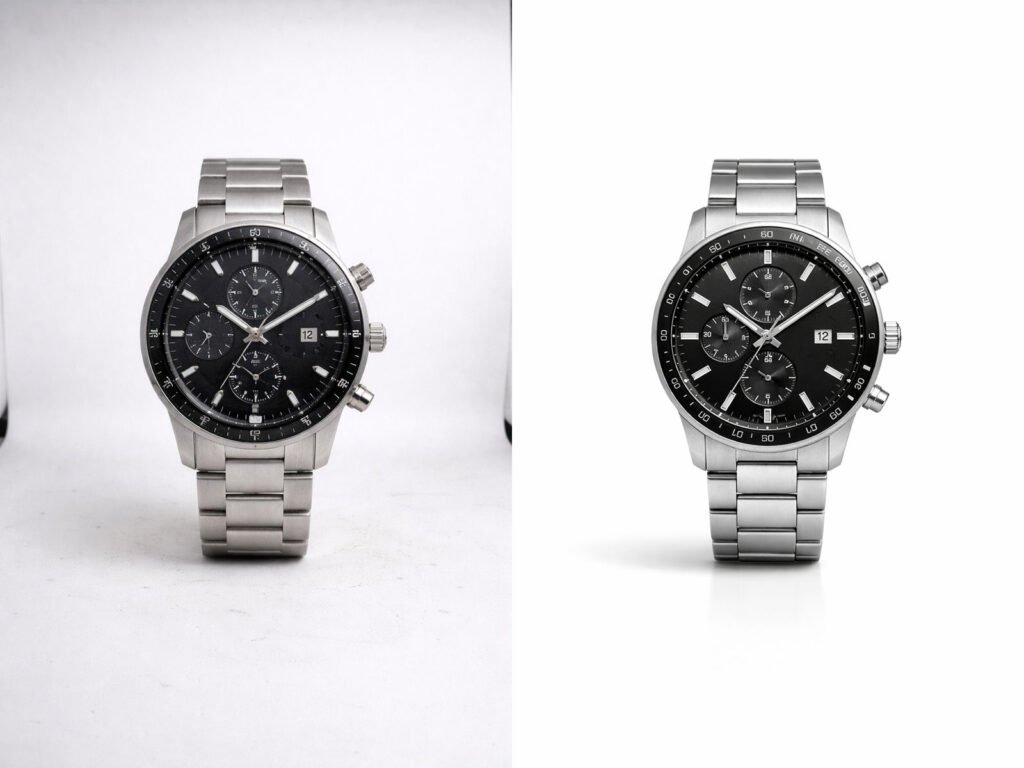
Watch face clarity represents the most critical element, requiring crystal-clear dials where every marker, hand, and complication remains sharp and legible. Retouching removes dust beneath crystals (if possible) and enhances contrast for maximum readability.
Glass reflection control balances showing crystal transparency with minimizing distracting glare. Some reflection suggests real glass rather than flat printed dials, but excessive reflection obscures dial viewing. Professional retouching finds this balance through selective opacity work.
Metal bracelet refinement applies the same principles as chain retouching but with added complexity from integrated link designs and brushed-plus-polished finishing combinations common in luxury watches.
Logo clarity enhancement sharpens brand names, model numbers, and trademark details without over-sharpening into unnatural crispness. These elements need legibility while maintaining photographic authenticity.
Leather strap texture requires preserving natural grain and patina while removing scratches and stains. Over-smoothing makes leather look plastic; proper retouching maintains organic character while presenting clean, appealing surfaces.
Jewelry Retouching Process and Preparation
Understanding the retouching workflow helps you prepare images properly, set realistic expectations for turnaround, and collaborate effectively with service providers.
Image Requirements and Upload Guidelines
File format requirements start with RAW files whenever possible, as these contain maximum image data for color correction and detail extraction. JPEG files work when properly captured at high quality settings, though compressed files limit retouching flexibility.
Resolution minimums ensure sufficient detail for professional retouching. Images should be at least 3000 pixels on the longest edge for standard e-commerce use, with larger dimensions for print applications or high-end campaigns. Lower resolution limits how much detail retouching can reveal or refine.
Background recommendations during shooting save retouching time and cost. Simple, neutral backgrounds (white, gray, or black) facilitate easier extraction than busy or textured surfaces. Evenly lit backgrounds reduce edge halos and make clean separation straightforward.
Shooting tips that ease retouching include using sufficient depth of field to keep jewelry sharp throughout, avoiding mixed lighting that complicates white balance, and keeping jewelry clean before shooting to minimize dust removal work.
Retouching Workflow Stages
Intake begins when you upload images to the retouching service, specifying requirements through web forms, sample markups, or detailed briefs. Clear communication at this stage prevents revision loops later—indicate which metals need polishing, whether gemstones should be enhanced, and what background treatment you want.
Cleanup forms the first processing stage, where retouchers remove dust, fingerprints, and obvious flaws before detailed work. This foundation ensures subsequent enhancements apply to clean surfaces rather than polishing over visible contamination.
Detail work follows cleanup, addressing metal surface refinement, gemstone enhancement, shape corrections, and other specialized techniques based on service tier. This stage represents the core retouching where jewelry transforms from acceptable to excellent.
Color correction happens after detail work, ensuring metals display accurate tones, gemstones show true colors, and overall images match brand standards or marketplace requirements. This stage often requires calibrated monitors and color-managed workflows.
Export and quality control conclude the workflow, where retouchers review work at 100% zoom before final file preparation. Images get resized, sharpened for output medium, converted to requested formats, and packaged for delivery.
Revision checkpoints let you review work in progress for complex projects, providing feedback before final completion. This collaborative approach prevents major rework and ensures results meet expectations.
Quality Control Standards
One hundred percent zoom inspection catches details invisible at normal viewing sizes—dust specks, minor edge artifacts, or incomplete cleanup that would frustrate customers examining products closely. Every professional retouching service should review work fully zoomed before delivery. At Pic Visual, we maintain rigorous quality standards and invite new clients to experience our precision through a free trial for jewelry retouching service.
Style guide compliance matters for brands and retailers with established visual standards. Retouchers reference these guides during processing, ensuring consistent metal treatment, background rendering, and enhancement levels across entire catalogs.
Before-after comparisons verify that retouching improved images without crossing into misrepresentation. Jewelry should look better but still recognizable as the same piece—colors stay accurate, textures remain believable, and proportions don’t shift.
Technical checklist review confirms exported files meet specifications: correct dimensions, proper color space, requested file format, appropriate naming conventions, and any platform-specific requirements like Amazon’s white background rules.
Secure File Transfer and Privacy Protection
Encryption during upload protects your jewelry images in transit, preventing interception by unauthorized parties. Professional services use secure HTTPS connections and may offer dedicated FTP servers for large file transfers.
Non-disclosure agreements formalize privacy commitments, particularly important for designers with unreleased collections or retailers working with exclusive jewelry lines. NDAs specify that retouchers cannot share, reproduce, or discuss your images outside the service relationship.
Storage policies determine how long retouching services keep your original files and finished images. Some services delete files immediately after project completion, while others maintain archives for specified periods allowing re-downloads. Understand these policies before uploading irreplaceable photography.
Access controls limit which team members handle your images, with some premium services offering dedicated retouchers who become familiar with your brand standards and preferences over time.
Turnaround Times and Revision Policies
Standard turnaround typically ranges from 24 to 72 hours depending on order volume and service tier. Basic cleanup processes faster than high-end luxury work; single images deliver quicker than 500-piece catalogs.
Express or rush services cut turnaround to same-day or overnight for urgent needs, charging premium fees for priority queue placement. These options suit product launches, time-sensitive campaigns, or situations where reshooting isn’t possible before deadlines.
Revision limits define how many adjustment rounds services include before charging extra. Typical policies allow one or two revision cycles for feedback like “enhance this diamond more” or “make the gold warmer.” Unlimited revisions sound appealing but often signal unclear processes that require excessive back-and-forth.
Revision turnaround affects project timelines—if standard work takes 48 hours but revisions add another 24-48 hours per round, plan accordingly when facing deadlines. Some services prioritize revision requests, while others queue them behind new orders.
E-commerce Marketplace Specifications
Amazon requirements mandate pure white backgrounds (RGB 255,255,255), images at least 1000 pixels on the longest side, products filling 85% or more of frame, and minimal props or text overlays. Professional jewelry retouching ensures compliance with these rules to prevent listing rejection.
Shopify flexibility allows varied background treatments and styling, but best practices still favor clean white or transparent backgrounds for product pages. Shopify’s image optimization recommendations include file sizes under 200KB for fast loading, achieved through proper JPEG compression or WebP conversion.
Etsy guidelines permit creative backgrounds and lifestyle styling alongside traditional white background images. Many Etsy jewelers mix both approaches—white backgrounds for primary product photos, lifestyle or textured backgrounds for additional images that show scale or styling.
eBay specifications resemble Amazon’s requirements with slight variations. Understanding each platform’s rules prevents listing delays and ensures maximum visibility in search results and category browsing.
Pricing and Service Packages
Understanding retouching pricing helps you budget appropriately and choose service tiers matching your quality needs and business model.
Pricing Tier Breakdown
Basic cleanup pricing starts around $2-5 per image for simple dust removal, basic background work, and minimal enhancement. This tier suits high-volume catalog work where thousands of SKUs need acceptable quality at minimal cost, or budget-conscious jewelers selling entry-level pieces.
Standard retouching ranges from $8-20 per image, adding metal surface refinement, gemstone enhancement, and more thorough cleanup to basic services. This mid-tier serves most professional jewelers and photographers needing polished results for mid-range to high-end jewelry without luxury campaign budgets.
High-end luxury retouching commands $30-100+ per image depending on complexity, with senior retouchers spending hours on single images for pixel-perfect results. Designer brands, large-format print campaigns, and luxury watch photography justify this investment through exceptional quality that standard tiers cannot match.
Per-service add-ons let you customize packages, paying base rates for basic work while adding specific enhancements. Common add-ons include advanced shadow creation ($3-5), complex compositing ($10-25), product color change services for showcasing jewelry in multiple metal options ($5-15), or rush processing ($5-15 premium).
Bulk Discount Structures
Volume breaks typically trigger at 50, 100, 250, and 500+ images, with discounts ranging from 10% at low volumes to 30-40% for very large orders. Jewelers shooting complete seasonal collections benefit substantially from bulk pricing.
Catalog projects often receive custom quotes based on total scope rather than per-image rates. A 1000-piece catalog might negotiate flat fees or tiered structures that reward larger commitments.
Monthly subscriptions suit jewelers with ongoing photography needs, offering allocated image credits per month at discounted rates. Unused credits might roll over or expire depending on terms, making these packages ideal for stores adding new inventory regularly.
Loyalty programs reward repeat clients with improved pricing, priority turnaround, or bonus credits. Establishing long-term relationships with retouching services often yields better value than shopping around for individual projects.
Subscription and Retainer Options
Monthly plans allocate specific image counts at reduced per-image costs—for example, 100 images monthly at $12 each rather than $15 pay-as-you-go rates. These work well for jewelers shooting new inventory consistently.
Annual commitments deepen discounts further but require predicting year-long needs accurately. The tradeoff between upfront commitment and savings depends on your business growth and photography volume predictability.
White-label partnerships for photography studios let you resell retouching under your brand, maintaining client relationships while outsourcing technical work. Services typically offer wholesale pricing tiers for these relationships.
Express Rush Fees
Same-day delivery adds significant premiums, often 50-100% above standard rates, but saves situations where reshooting isn’t possible before imminent deadlines. Product launch dates, print production schedules, or time-sensitive campaigns justify rush costs.
Overnight turnaround costs less than same-day but still commands premiums of 25-50%. This option balances urgency with budget when you have slight flexibility.
Weekend processing availability varies by service, with some offering weekend work at rush rates while others reserve weekends for backlog clearing without rush fees.
Service Comparison Table
| Service Tier | Price Range | Turnaround | Included Services | Best For |
| Basic Cleanup | $2-5/image | 24-48 hours | Dust removal, basic scratches, fingerprints, simple background removal | Budget catalogs, entry-level jewelry, high-volume needs |
| Standard | $8-20/image | 48-72 hours | Full cleanup, metal refinement, gemstone enhancement, professional backgrounds, shadows | Most professional jewelry, mid to high-end products |
| High-End Luxury | $30-100+/image | 3-7 days | Pixel-perfect detail, micro-refinement, complex composites, campaign-ready quality | Designer brands, luxury watches, large-format print, advertising campaigns |
| Bulk Catalog | Custom quote | Varies | Tiered pricing based on volume, consistent quality across thousands of images | Seasonal collections, complete catalog photography |
| Rush Express | +50-100% fee | Same-day/overnight | Priority queue placement, dedicated retoucher attention | Urgent deadlines, product launches, time-sensitive campaigns |
Understanding What Affects Pricing
Image complexity drives pricing more than jewelry value—a $500 ring with intricate pavé setting and rose gold details requires more retouching time than a $5000 simple platinum band. Estimate costs based on retouching difficulty rather than product price.
Current image quality affects required work. Well-photographed jewelry with minimal flaws needs less cleanup than poorly lit, dusty shots requiring extensive correction. Improving photography technique reduces long-term retouching costs.
Output requirements influence pricing when you need specialized formats, color spaces, or multiple size variations. Simple JPEG delivery costs less than comprehensive packages with print-ready TIFF files, web-optimized WebP versions, and social media crops.
Revision expectations matter during price negotiation. Services offering unlimited revisions either charge higher base rates or have unclear processes requiring excessive back-and-forth. Defined revision limits (typically 1-2 rounds) with additional charges for excessive changes keeps pricing predictable.
Professional Use Cases and Applications
Different professionals have distinct retouching needs based on business models, client requirements, and output purposes.
Jewelers and Jewelry Manufacturers
Catalog production represents the primary retouching need for jewelers, requiring consistent quality across hundreds or thousands of SKUs. Bulk pricing and established workflows streamline seasonal collection photography, ensuring new inventory reaches websites and marketplaces quickly.
Lookbook creation for wholesale buyers demands higher quality than standard e-commerce, with enhanced detail work that impresses retail buyers reviewing collections. These images often require print-ready resolution and color accuracy for physical catalogs.
Rebranding projects need comprehensive retouching across entire existing catalogs when jewelers refresh their visual identity. Rather than reshooting everything, retouching can update backgrounds, adjust color grading, and unify styling across older photography.
Custom piece documentation captures one-of-a-kind creations for portfolios and customer records. High-end retouching ensures these special pieces receive appropriate treatment, worthy of the craftsmanship invested.
Professional Photographers and Studios
Workflow scaling challenges photographers as client rosters grow—shooting more jewelry means less time for post-production. Outsourcing retouching to specialized services like Pic Visual frees photographers for revenue-generating activities like new shoots or client consultations.
White-label retouching partnerships let photography studios maintain brand consistency while leveraging external expertise. Clients receive results under the studio’s name, unaware of outsourcing, allowing photographers to promise professional retouching without hiring in-house staff.
Time management benefits prove substantial. A photographer shooting 50 rings in a day can send those images for next-day retouching delivery rather than spending a week in post-production, dramatically improving business throughput and client turnaround.
Quality consistency across large orders becomes easier when dedicated retouching teams follow established style guides, ensuring every image in a 200-piece catalog meets the same standards despite being processed by multiple retouchers.
Advertising Agencies and Luxury Brands
Campaign retouching for print and digital advertising demands absolute perfection, with senior retouchers spending days on single hero images for magazine spreads, billboards, or luxury brand websites. Every pixel undergoes scrutiny, justifying premium pricing through flawless results. The power of high-end product photo retouching becomes especially evident in luxury jewelry campaigns where perfection is non-negotiable.
Brand consistency across multichannel campaigns requires detailed style guides specifying exactly how jewelry should appear across all touchpoints. Retouching teams work from these guides, ensuring catalog images, social media content, and advertising photography maintain cohesive aesthetics.
Print-ready output preparation involves specialized knowledge of color spaces, resolution requirements, and printing processes. Images for high-end jewelry catalogs need CMYK conversion with custom ICC profiles matching specific paper stocks and printing equipment.
Composite creation for impossible shots combines multiple photographs into single images showing jewelry from angles or clarity levels unachievable in single captures. Watches might composite dial details, case finishing, and bracelet sections into unified presentations.
Color accuracy for product representation prevents customer disappointment and returns. Professional retouching uses calibrated monitors and color-managed workflows to ensure rose gold appears accurately rose, sapphires show true blue tones, and diamonds reflect genuine clarity.
E-commerce Retailers and Marketplaces
Platform compliance represents the baseline requirement, with retouching ensuring all images meet Amazon, Etsy, Shopify, and eBay specifications for backgrounds, sizing, and styling. Non-compliant images face listing rejection, delaying product launches.
Conversion optimization through professional imagery directly impacts sales metrics. A/B testing consistently shows that professionally retouched jewelry photos convert higher than unedited shots, justifying retouching costs through increased revenue.
Return reduction occurs when product photography accurately represents jewelry appearance, color, and quality. Customers receiving pieces matching their online expectations return items less frequently, improving profitability beyond initial conversion benefits.
Seasonal refresh projects update catalog photography for holidays, Valentine’s Day, or wedding season promotions. Rather than full reshoots, retouching can adjust colors, update backgrounds, or enhance specific elements to refresh existing images economically.
Frequently Asked Questions About Jewelry Retouching
What exactly does jewelry retouching include?
Jewelry retouching encompasses dust and scratch removal, metal surface refinement, gemstone brilliance enhancement, background removal or replacement, color correction, shape and symmetry fixes, and shadow or reflection creation. Specific inclusions vary by service tier, with basic packages covering cleanup and backgrounds while high-end services add extensive detail refinement and compositing. At Pic Visual, we customize our approach based on your jewelry type and intended use.
How long does jewelry retouching take?
Standard turnaround ranges from 24 to 72 hours depending on service tier and order volume. Basic cleanup often delivers within 24-48 hours, while high-end luxury work may require 3-7 days for extensive hand-work. Express rush services offer same-day or overnight delivery at premium rates. Large catalog orders require custom timelines based on total image count.
Can retouching fix badly photographed jewelry?
Retouching can correct many photography issues including dust, scratches, color casts, and basic exposure problems. However, fundamental issues like severe blur from camera shake, completely blown highlights without detail, or extreme underexposure limiting shadow detail may prove impossible to fix fully. Good photography maximizes retouching potential, while poor capture quality limits achievable results.
Is jewelry retouching ethical?
Ethical retouching enhances presentation while maintaining honest product representation. Removing dust, scratches, and fingerprints that aren’t part of the actual jewelry is acceptable. So is enhancing natural gemstone brilliance and metal luster without misrepresenting materials or quality. Unethical retouching would involve changing stone colors, adding features not present, or implying higher quality than reality. Professional services like Pic Visual understand these boundaries and refuse requests that cross into misrepresentation, maintaining product authenticity while maximizing visual appeal.
What file formats do I need to provide?
RAW files (NEF, CR2, ARW, etc.) provide maximum retouching flexibility for color correction and detail work. High-quality JPEG files work when RAW isn’t available, though they limit adjustment range. Images should be at least 3000 pixels on the longest edge for standard e-commerce use, with larger dimensions for print applications. Avoid heavily compressed or resized files that lack detail for professional retouching.
What formats will I receive?
Standard delivery includes JPEG files optimized for web use in sRGB color space. Upon request, services provide PNG files with transparent backgrounds, TIFF files for print production, or WebP formats for modern websites. Some services deliver multiple formats simultaneously—JPEG for immediate use plus PNG with transparency for flexibility.
How do bulk pricing discounts work?
Volume discounts typically begin at 50 images with increasing breaks at 100, 250, and 500+ images. Discounts range from 10% for modest volumes to 30-40% for very large orders. Some services offer monthly subscriptions allocating image credits at reduced per-unit costs, beneficial for jewelers with ongoing photography needs. Custom catalog quotes may apply different pricing structures for thousand-image projects.
Can you match specific brand aesthetics?
Professional retouching services work from style guides that specify metal treatment, gemstone enhancement levels, background preferences, and overall aesthetic direction. Providing sample images demonstrating desired results helps retouchers match your brand identity. White-label services for photography studios excel at learning and maintaining client-specific aesthetics across multiple projects.
What about revisions if I’m not satisfied?
Most services include one to two revision rounds in base pricing, allowing feedback like “enhance this diamond more” or “warm up the gold tone.” Additional revisions beyond included limits typically incur fees. Unlimited revision policies sound appealing but often indicate unclear processes. Clear initial communication about requirements minimizes revision needs.
Do you work with watch photography?
Watch retouching requires specialized expertise in dial clarity, glass reflection control, and metal bracelet refinement. Not all jewelry retouching services handle watches well, so verify experience with timepieces when evaluating providers. High-end watch retouching involves particular attention to brand logo clarity, complication visibility, and integrated bracelet finishing.
Is AI retouching as good as manual work?
AI tools excel at basic cleanup tasks like dust removal in high-volume scenarios but struggle with complex reflections, subtle metal textures, and gemstone enhancement requiring aesthetic judgment. Hybrid workflows combining AI efficiency for initial passes with human refinement offer good middle-ground options. High-end luxury work demands manual processing for quality that AI cannot replicate.
How do you ensure my images stay private?
Professional services use encrypted file transfer, signed non-disclosure agreements, and secure storage with access controls limiting which team members view your images. Storage policies specify retention periods, with some services deleting files immediately post-delivery while others maintain archives allowing re-downloads. Verify privacy protections before uploading proprietary or unreleased collection photography.
Can retouching help my e-commerce conversion rates?
E-commerce testing consistently demonstrates that professionally retouched jewelry images convert higher than unedited photos. Clean, sparkling product shots build customer confidence and reduce perceived purchase risk. Enhanced detail visibility lets customers zoom into jewelry appreciating craftsmanship, while accurate color representation reduces returns from unmet expectations. The investment in professional retouching typically shows positive ROI through improved sales metrics. Pic Visual’s jewelry retouching services focus specifically on e-commerce optimization to maximize your conversion potential.
Technical Considerations for Advanced Users
Color Space Management for Print and Web
sRGB serves as the standard color space for web display, ensuring consistent appearance across different browsers, devices, and operating systems. All e-commerce jewelry photography should use sRGB to prevent color shifting when customers view images on phones, tablets, or computers.
Adobe RGB offers wider color gamut for print production, capturing richer tones particularly in saturated hues like vibrant gemstones. Professional printing workflows use Adobe RGB files converted to CMYK with custom ICC profiles matching specific paper and press combinations.
ProPhoto RGB extends even further than Adobe RGB but risks compatibility issues and requires careful handling. This color space suits only specific high-end workflows where maximum color capture during initial editing matters, with conversion to Adobe RGB or sRGB for final delivery.
Color-managed workflows from capture through editing to export maintain consistency by embedding and honoring color profiles. Calibrated monitors displaying known color spaces prevent the guesswork of editing on uncalibrated displays where colors may appear incorrect.
File Format Selection for Different Applications
JPEG remains the web standard, offering small file sizes through lossy compression while maintaining acceptable quality for screen viewing. Quality settings of 80-90% balance file size against visible compression artifacts. JPEG doesn’t support transparency, limiting it to photos with backgrounds intact.
PNG provides lossless compression and transparency support through alpha channels, making it essential for jewelry extracted to transparent backgrounds. PNG files run larger than JPEG but preserve every pixel perfectly, important when images undergo further processing or layering.
TIFF files suit print production and archival storage, supporting multiple layers, large color depths, and lossless compression. Print-ready jewelry images often deliver as TIFF files at 300 DPI with Adobe RGB color space and embedded ICC profiles.
WebP represents a modern format offering better compression than JPEG while supporting transparency like PNG. Many jewelry websites now use WebP for faster loading without quality sacrifice, though some older browsers lack support.
Resolution Requirements for Various Uses
Web display needs 72-96 DPI at displayed dimensions, meaning a 1500-pixel wide image shows at full resolution on most monitors. Higher resolution offers no visual benefit for screen viewing but increases file size and loading time. However, many e-commerce sites use larger source files enabling zoom functionality, requiring 3000+ pixel dimensions even for web display.
Print production demands 300 DPI at final printed size. A jewelry image printing at 4 inches wide needs 1200 pixels minimum; larger prints require proportionally more. Professional printing often recommends 300-400 DPI for best results, with 240 DPI acceptable for certain applications.
Large-format prints like billboards or trade show displays paradoxically require lower DPI than small prints because viewing distance increases. A 10-foot wide billboard might use 100-150 DPI effectively since no one views it from inches away.
Social media platforms apply their own compression and resizing, making moderate resolution sufficient. Instagram recommends 1080 pixels for square posts, Facebook supports up to 2048 pixels for optimal quality, and Pinterest prefers taller aspect ratios around 1000×1500 pixels.
Monitor Calibration for Accurate Color
Calibrated displays show colors accurately, preventing situations where jewelry edited on uncalibrated monitors appears different when customers view it on their screens or when printed. Hardware calibration devices like X-Rite ColorMunki or Datacolor SpyderX measure monitor output and create ICC profiles correcting color display.
Calibration frequency depends on monitor type and usage intensity. Professional workflows calibrate monthly, while less demanding uses might calibrate quarterly. Monitors drift over time, particularly as backlights age, making periodic recalibration essential for color accuracy.
Room lighting affects color perception even on calibrated monitors. Neutral lighting around 5000K-6500K (daylight balanced) prevents color contamination from warm incandescent or cool fluorescent ambient light influencing color judgment during editing.
Ethical Boundaries in Jewelry Retouching
Product honesty requires that retouched images represent actual jewelry accurately. Removing dust and fingerprints is ethical because they’re not part of the product. Enhancing natural gemstone brilliance within reason maintains authenticity. Changing stone colors, adding features not present, or implying different materials crosses into misrepresentation.
Marketplace policies often specify retouching limits. Amazon requires images showing products as-is without adding props, text, or misleading enhancements. While dust removal and basic cleanup prove acceptable, extreme beautification that misrepresents product quality violates these policies.
Customer satisfaction and return rates connect directly to image accuracy. Over-retouched jewelry that looks substantially different in person generates returns, negative reviews, and customer service issues outweighing any initial conversion benefits from enhanced images.
Professional standards in the jewelry industry increasingly emphasize authentic representation, with organizations providing guidelines distinguishing acceptable enhancement from problematic manipulation. Following these standards builds long-term customer trust worth more than short-term conversion gains from exaggerated imagery.
Conclusion: Maximizing Your Jewelry Photography Investment
Professional jewelry retouching transforms ordinary product photography into compelling sales tools that build customer confidence and drive conversions. Whether you’re managing a small Etsy shop with dozens of handmade pieces or overseeing thousands of SKUs for a jewelry manufacturer, understanding retouching services helps you choose appropriate quality tiers, budget effectively, and communicate requirements clearly.
The investment in professional retouching pays returns through improved conversion rates, reduced return rates from accurate representation, and time savings that let you focus on core business activities rather than technical post-production. Starting with basic cleanup for budget-conscious needs and scaling to high-end jewelry retouching services for premium products allows you to match retouching investment to business requirements.
Success in jewelry e-commerce increasingly depends on visual presentation quality. As marketplaces grow more competitive and customers expect professional imagery across all price points, professional retouching becomes less optional luxury and more operational necessity. Services offering bulk discounts, monthly subscriptions, and white-label partnerships make professional retouching accessible for businesses of all sizes.
Moving forward, evaluate retouching providers based on portfolio quality, process transparency, technical capabilities matching your specific needs, and pricing structures aligning with your volume and budget. Strong provider relationships built on clear communication, realistic expectations, and mutual understanding of quality standards yield best results over time.
Ready to elevate your jewelry photography? Pic Visual specializes in professional jewelry retouching that enhances natural beauty while maintaining authentic product representation. From basic cleanup to luxury campaign work, our experienced team delivers consistent quality across every project. Start with our free trial to experience the difference professional retouching makes for your jewelry business.
Your jewelry deserves presentation matching its craftsmanship. Professional retouching provides that final polish transforming acceptable product photos into irresistible visual experiences that convert browsers into buyers and one-time customers into loyal brand advocates.

